Information on the history of Eswatini , Swaziland and and Surrounding Towns
This website provides information on eSwatini , Swaziland accommodation and tourist destinations within the Kingdom of eSwatini , Swaziland
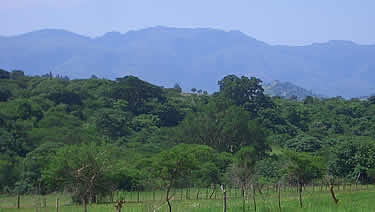
There are various indigenous things to do and places to see in eSwatini , Swaziland including adventure activities such as horse riding, bird watching/trails safaris, walking/hiking, fishing, mountain quad biking and bushman paintings.
Each of the towns or areas listed above have their own unique tourist destinations and tourist activities.
Each of the towns in this site cater for all tourist requirements with regards to accommodation in eSwatini , Swaziland - be it a bed and breakfast accommodation, a Game Farm experience, Hotel accommodation, Guest Lodge or self-catering accommodation.
They cater for tourists, locals, businessmen, backpackers, holiday makers and family groups: ranging from budget accommodation to ultra-luxury accommodation.
There is something for everyone!
CULTURAL ACTIVITIES
Most visitors to eSwatini , Swaziland are attracted by the Reed Dance which is also known as Umhlanga which takes place in late August or early September, where teenagers from all over the kingdom take part. The aim of the ceremony are to:
1. Preserve girl's chastity
2. Provide tribute labour for the queen mother
3. Produce solidarity by working together
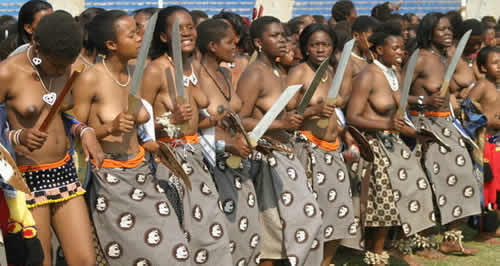
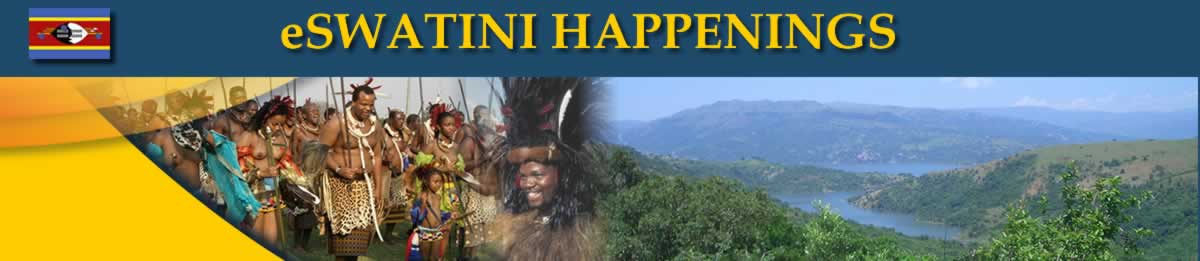
Umhlanga provides the maidens with an opportunity to pay tribute to the Queen Mother (Indlovukazi). The girls collect the reeds from certain selected areas, whereby the older ones travel long distances while the younger ones travel short distances.... Read more
The Incwala Ceremony or First Fruit Ceremony in which the king plays a governing role is the most consecrated of all the Swazi rituals. It is one of the Swazi rituals that attracts most tourists into the kingdom.
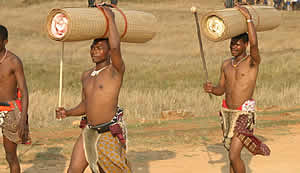
The Incwala Ceremony is held in December or January on a date chosen by the astrologers in conjunction with the phases of the moon. It starts when the people of the water (Bemanti) takes a journey to the Indian Ocean to collect water.... Read more
There are many places to see and things to do in the kingdom.
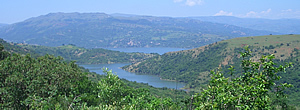
Maguga Dam is beautifully set between the Matsamo border post and the Capital City-Mbabane.
Lovely bushman (San rock art )paintings can be found mostly in the western highveld areas - also a very beautiful place .
HISTORY
Human remains and artifacts from more than 100,000 years ago have been found in eSwatini , Swaziland. The earliest inhabitants of the area were Khoisan hunter-gatherers . They were largely replaced by Bantu tribes during Bantu migrations . Evidence of agriculture and iron use dates from about the 4th century , and people speaking languages ancestral to current Sotho and Nguni languages began settling no later than the 11th century . The ruling Dlamini lineage had chiefships in the region in the 18th century . An enlarged Swazi kingdom was established by King Sobhuza I in the early 19th century . Soon thereafter the first whites started to settle in the area. The ancestors of the Swazi probably moved into the Mozambique area from the north prior to the 16th cent. Fleeing Zulu attacks in the early 19th cent., they settled in present-day eSwatini , Swaziland.
During the 1800s, Europeans entered the area to seek concessions, and in 1894, eSwatini , Swaziland became a protectorate of the Transvaal. In 1906, eSwatini , Swaziland became a High Commission Territory ruled by a British commissioner. Limited self-government was not granted until 1963, and four years later eSwatini , Swaziland became a kingdom under a new constitution. On Sept. 6, 1968, eSwatini , Swaziland achieved complete independence but retained membership in the Commonwealth of Nations.The king became the head of state, administering through a cabinet and a prime minister chosen by parliament.
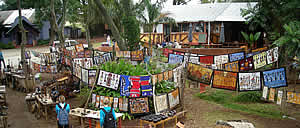
eSwatini , Swaziland is filled with most talented people.
There is jewellery, pottery, stone caving and wooden items such as bowls and knobkerries. Most of the handcraft can be seen and bought from our different outlets found at Ezulwini, Mbabane and Manzini.
eSwatini , Swaziland's arts and craft are mainly done by women as a means of generating income. Different unique craft shops are found at the Mantenga craft as it is a midpoint for all art and craft manufactures all over the country. The various craft outlets include Rosecraft, Kaya Craft, Benguni Craft, Shiba rags and African Fantasy.
eSwatini , Swaziland crafts ranges from wooden sticks, knobkerries, sisal baskets, woven mats shawls, bags and many more.
More arts and crafts can be seen at Malkerns valley where uniquely handicraft candles can be seen at the Swazi candles factory. 5km from the Oshoek border post and 16 km from Mbabane there is Ngwenya Glass factory where products of excellence are produced with an outstanding remark by skillful Swazi glass blowers.
National Anthem eSwatini , Swaziland
Nkulunkulu Mnikati wetibusiso temaSwati; Siyatibonga tonkhe tinhlanhla, Sibonga iNgwenyama yetfu, Live netintsaba nemifula. Busisa tiphatsimandla takaNgwane Nguwe wedvwa Somandla wetfu; Sinike kuhlakanipha lokungenabucili Simise usicinise, Simakadze.
Translation
O Lord our God, bestower of the blessings of the Swazi; We give Thee thanks for all our good fortune; We offer thanks and praise for our King And for our fair land, its hills and rivers. Thy blessings be on all rulers of our Country; Might and power are Thine alone; We pray Thee to grant us wisdom without deceit or malice.
Establish and fortify us, Lord Eternal.
Words by ANDREASE ENOKE FANYANA SIMELANE (1934-) Music by DAVID KENNETH RYCROFT (1924-)
Visitors can also get into the Swazi kingdom by road through thirteen border posts which are open seven days a week with varying operating hours.
The eSwatini , Swaziland National Museum displays natural, cultural heritage, traditional dresses and life styles.
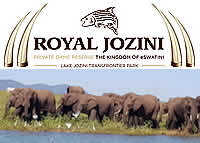
There are game reserves that grant our visitors the opportunity to see the magnificent wildlife we have in eSwatini , Swaziland:the Big 5 and a wide variety of game can be seen at our spectacular game reserves including : Phophonyane Nature Reserve, Mbuluzi Nature Reserve, Mkhaya Game Reserve, Mlilwane Game Reserve, and many more
The largest game reserve in the Kingdom is Hlane National Royal Park which covers 30.000 hectares. Hlane Royal National Park accommodates mostly lion, elephant, rhino and the leopard and other animals including hippopotamus, giraffe, crocodile, blue wildebeest and many more. Also the park offers a game viewing for their visitors in a comfortable open land rover. Hlane offers highly secured grounds where visitors can roam in the area freely on self guided trails.
Wonderful bird life abounds in eSwatini , Swaziland, making it a bird watcher's paradise.
Our visitors can get to eSwatini , Swaziland by air, the Matsapha international airport located few kilometers away from Manzini provide luxurious airlines for tourists to fly into the kingdom conveniently. Swazi Express Airlines is one of the luxurious airlines which fly regular flights between eSwatini , Swaziland, Durban and Maputo.
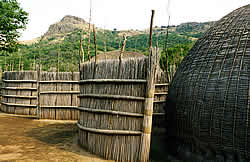
The principal Swazi social unit is the homestead, a traditional beehive hut thatched with dry grass. In a polygamous homestead, each wife has her own hut and yard surrounded by reed fences.
There are three structures for sleeping, cooking, and storage (brewing beer). In larger homesteads there are also structures used as bachelors' quarters and guest accommodation.
Central to the traditional homestead is the cattle byre, a circular area enclosed by large logs intersperced with branches. The cattle byre has ritual as well as practical significance as a store of wealth and symbol of prestige. It contains sealed grain pits.
Facing the cattle byre is the great hut which is occupied by the mother of the headman.
GEOGRAPHY OF eSWATINI , Swaziland
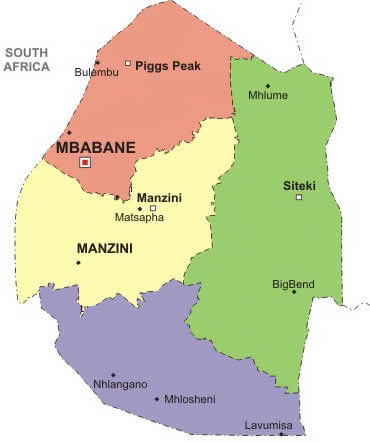
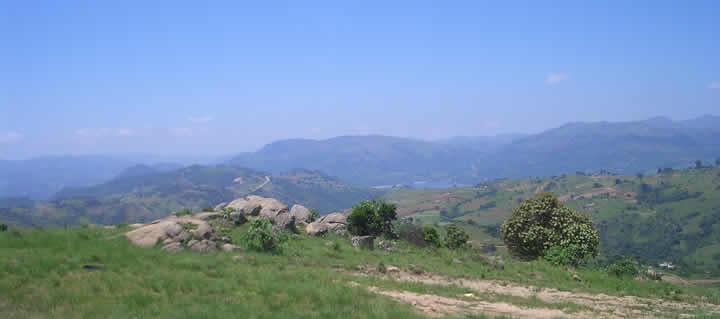
eSwatini , Swaziland has four geographical regions together with its major towns Hhohho, Lubombo, Shiselweni, Manzini, Mbabane, Siteki, Piggs Peak and Nhlangano.
Manzini mainly known as the hub of eSwatini , Swaziland and formerly known as the Bremersdorp has the largest urban population in the kingdom. Mbabane is the capital town of eSwatini , Swaziland and it is mostly surrounded by government offices and has less population than Manzini approximately 40,000 inhabitants .eSwatini , Swaziland has its own spectacular and unique cultural values which attracts most people all over the world.The Reed Dance and the Incwala Ceremonies are the events that the kingdom's visitors mostly admire.
CLIMATE
December - mid-summer
June - mid-winter.
Rain falls mostly during the summer months, often in the form of thunderstorms.
Winter is the dry season.
Annual rainfall is highest on the Highveld in the West, between 1,000 and 2,000 mm (39.4 and 78.7 in) depending on the year.
The further East, the less rain, with the Lowveld recording 500 to 900 mm (19.7 to 35.4 in) per annum.
The Highveld temperature is temperate and, seldom, uncomfortably hot while the Lowveld may record temperatures around 40 °C (104 °F) in summer.
QUEEN MOTHERS IN eSWATINI , Swaziland HISTORY
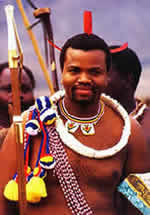
Queen Mother Labotsibeni , Queen Dzeliwe-Inkhosikati Lashongwe and the current Queen, Queen Indlovukati Ntfombi. Queen Mother Labotsibeni was a dual monarch which held political influence equal to a king and she also had supernatural powers to make it rain. In August 1982 Dzeliwe was named Queen Regent by the Royal Congress but there was a disagreement between the Prime Ministers and in 1983 she was replaced by the mother of Makhosetive Ntfombi as regent. The current Queen Idnlovukati joined the Head of State in 1986 and is currently Joint Head of State.
|